
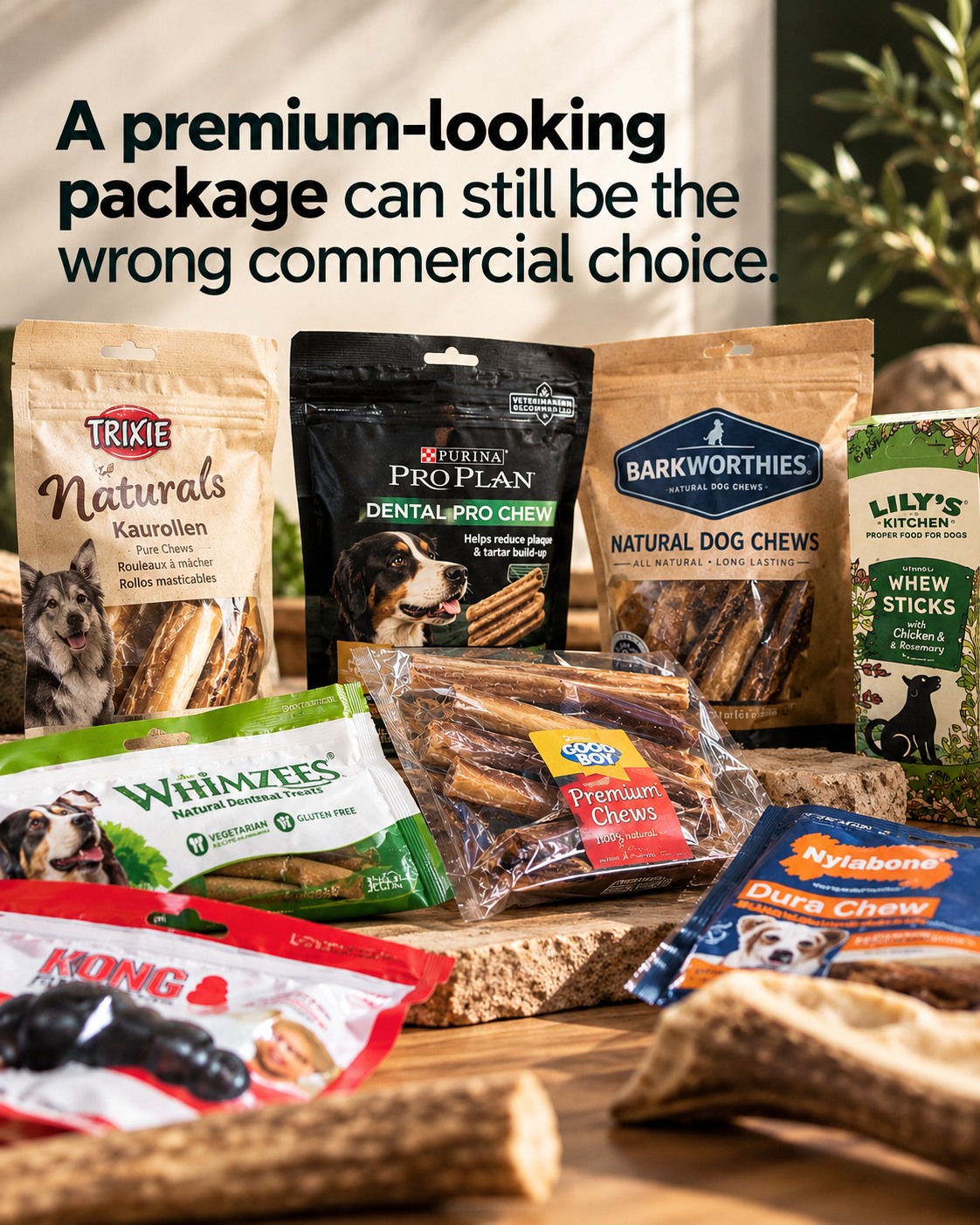
A Premium-Looking Package Can Still Be the Wrong Commercial Choice
A Premium-Looking Package Can Still Be the Wrong Commercial Choice
Packaging can attract attention, communicate quality and help a product stand out. But for distributors, retailers and private-label buyers, an attractive package is only one part of the decision.
When sourcing natural dog chews and other pet products, packaging must be evaluated in the context of the product itself, its intended sales channel, relevant information requirements and the overall commercial proposition.
A package can look excellent and still leave important questions unanswered.
Before choosing a packaging format, professional buyers should consider five factors: product protection, clarity, information, suitability and total landed cost.
1. Product Protection: Is the Packaging Suitable for the Product?
The first question is practical: does the packaging format suit the product’s characteristics and expected handling conditions?
For natural dog chews, buyers should consider the requirements associated with storage, transport, distribution and retail handling. The appropriate solution depends on the specific product and its packaging specifications.
A visually appealing package is not enough if its suitability for the intended supply chain has not been established.
Questions buyers should ask:
- Is the proposed format appropriate for the product?
- Have storage and handling requirements been considered?
- Is the packaging suitable for the expected distribution process?
- What information or evidence is available to support the proposed specification?
Evaluating these questions early helps buyers establish clear expectations before approving a packaging format.
2. Shelf Clarity: Can Customers Understand the Product Quickly?
At the point of sale, customers need to understand what they are looking at.
Clear product identification and an effective visual hierarchy can help customers navigate a range without having to interpret an overcrowded label or confusing presentation.
For retailers and distributors, this matters when comparing products, organizing a range and considering how individual items will appear alongside competing offers.
Questions buyers should ask:
- Is the product easy to identify?
- Is the most relevant information easy to find?
- Is the presentation appropriate for the intended customer and sales channel?
- Does the design communicate clearly without unnecessary complexity?
Premium presentation does not have to mean elaborate design. Often, clarity is the more useful starting point.
3. Information: Are the Relevant Product Details Easy to Find?
Packaging also plays an informational role.
Buyers need access to the details relevant to their purchasing decisions, while the information presented to consumers must be appropriate for the product and applicable market requirements.
Depending on the product and intended market, relevant details may include product identity, net quantity, feeding guidance, storage information, traceability details or other applicable information.
The exact requirements must be confirmed for the specific product and market rather than assumed to be identical across every pet product category.
Questions buyers should ask:
- Are the relevant product details available?
- Is the information presented clearly?
- Have the applicable market requirements been identified?
- Are claims supported by appropriate documentation?
Clear information helps buyers evaluate an offer and establish what needs to be confirmed before a product enters a retail range.
4. Format Suitability: Does the Packaging Fit the Intended Channel?
There is no single packaging format that works equally well for every product, retailer or customer.
A format should be evaluated in relation to the product, intended retail channel, storage and handling needs, customer expectations and commercial requirements.
For private-label buyers, this discussion may also involve artwork, labelling, pack dimensions, specification approval and other project-specific requirements.
Questions buyers should ask:
- Does the format suit the intended product range?
- Is it appropriate for the target sales channel?
- Have relevant storage, handling and presentation requirements been considered?
- Are the required specifications and approval responsibilities clearly defined?
A clear packaging brief helps buyers and suppliers understand what is required before making decisions about the final format.
5. Total Landed Cost: Does the Commercial Calculation Make Sense?
The purchase price of packaging—or the unit price of a finished product—does not necessarily represent the complete commercial cost.
Depending on the transaction, buyers may need to consider transport, handling, storage, applicable charges and other costs involved in getting the product to its intended destination.
These factors should be evaluated alongside the packaging’s suitability, rather than considered in isolation.
Questions buyers should ask:
- What is included in the quoted price?
- Which transport and handling costs apply?
- Are there additional requirements that affect the overall cost?
- Does the total landed cost support the intended commercial proposition?
A lower-cost option is not automatically the better choice if it fails to meet the product’s requirements or creates additional costs elsewhere in the supply chain.
The objective is to understand the complete offer before making a decision.
A Note on Packaging Materials and Environmental Claims
Material choice and environmental claims may also form part of a packaging evaluation, particularly when products are intended for European markets.
Buyers should distinguish between specific, verifiable statements and broad claims about sustainability or recyclability. Such claims should be supported by appropriate evidence and assessed against the requirements applicable to the product and market.
The EU Packaging and Packaging Waste Regulation began applying generally on 12 August 2026, with individual provisions and obligations following different timelines. Businesses should establish which requirements apply to their packaging and their role in the supply chain.
Rather than assuming that a particular material or format is automatically preferable, buyers should request the relevant specifications and supporting information.
The Buyer’s Checklist: Five Questions Before Choosing Packaging
Before approving a packaging format for a natural dog chew product, consider the following:
- Protection: Is the format appropriate for the product and its expected handling conditions?
- Clarity: Can customers identify the product and understand its presentation?
- Information: Are the relevant details available, clear and appropriate for the intended market?
- Suitability: Does the format fit the product, sales channel and customer requirements?
- Cost: Does the total landed cost make commercial sense?
These questions provide a practical starting point for supplier discussions, product evaluations and private-label projects.
They also help identify unanswered questions before a buyer commits to a particular specification.
Final Thoughts: Packaging Is Part of the Commercial Decision
A premium-looking package can make a strong first impression, but appearance alone cannot establish whether a packaging format is appropriate for a product or a business.
For distributors, retailers and private-label buyers, the better approach is to evaluate the complete picture: protection, clarity, information, suitability and cost.
The right decision depends on the product, the intended market and the buyer’s commercial requirements.
At DEER EXPORT, we believe productive B2B conversations begin with clear product and commercial requirements.
Discuss your natural dog chew sourcing requirements with DEER EXPORT. Whether you are evaluating a product range or exploring a potential sourcing relationship, start by defining the product, packaging and market requirements that matter to your business.
Packaging specifications, product availability, materials, capabilities and compliance requirements should be confirmed for each specific enquiry. This article provides general buyer guidance and does not constitute legal or regulatory advice.