
Why Quality Consistency Matters
Why Quality Consistency Matters for Distributors
When buying natural pet products, quality is only part of the equation.
For distributors, retailers and pet brands, the real challenge lies in finding a supplier that can deliver both a consistent product and a consistent experience over time.
This matters particularly when businesses work with natural materials. Natural deer antlers do not come in identical forms. Their shape, colour, texture and structure naturally vary. Therefore, professional buyers need not artificial uniformity, but clear expectations, reliable specifications and consistent quality standards.
Quality Once Is Not Enough
Receiving a high-quality product once is positive.
However, consistently receiving products that meet agreed expectations builds a reliable supply relationship.
For a distributor, inconsistency can create problems throughout the supply chain. Differences in product presentation, sizing, specifications or availability, for example, can make it more difficult to plan inventory, manage customer expectations and maintain a consistent product range.
For this reason, buyers should consider quality consistency part of the supplier relationship, not simply a characteristic of an individual product.
What Does Consistency Mean for Natural Deer Antlers?
Consistency does not mean that every antler should look exactly the same.
After all, natural products do not work that way.
Instead, consistency means understanding what the supplier provides and maintaining agreed expectations across orders.
For professional buyers, this can include:
- Clear product specifications
- Consistent size and format expectations
- Reliable quality standards
- Appropriate product selection
- Traceability
- Clear communication
- Reliable supply planning
When suppliers establish these elements clearly, buyers can manage natural variation more effectively. As a result, they can work with the product’s natural characteristics while still planning effectively.
Why Consistency Matters to Distributors
Distributors sit between suppliers and their own customers.
As a result, reliability becomes particularly important.
A distributor may need to:
- Plan inventory months in advance.
- Supply multiple retailers or brands.
- Maintain agreed product specifications.
- Forecast demand.
- Coordinate international shipments.
- Answer customer questions about the products.
- Build a reputation for reliability themselves.
A consistent supplier relationship makes these tasks easier to manage. In addition, predictable supply supports better planning across the wider business.
By contrast, changing expectations from one order to another can make even a good product difficult to sell and plan around.
Consistency Builds Customer Confidence
The final customer may never meet the supplier behind a product.
Instead, they experience the product through the retailer or brand that sells it.
Consequently, supplier-level consistency can ultimately influence the customer experience.
For example, if a retailer develops a natural chew range around particular formats and specifications, they need confidence that future orders will continue to meet those expectations.
The goal is not to eliminate the product’s natural characteristics.
Rather, suppliers should make those characteristics understandable and manageable. In this way, natural products can remain authentic while still meeting commercial needs.
Natural Variation Is Not the Same as Inconsistency
This distinction matters particularly when businesses work with deer antlers.
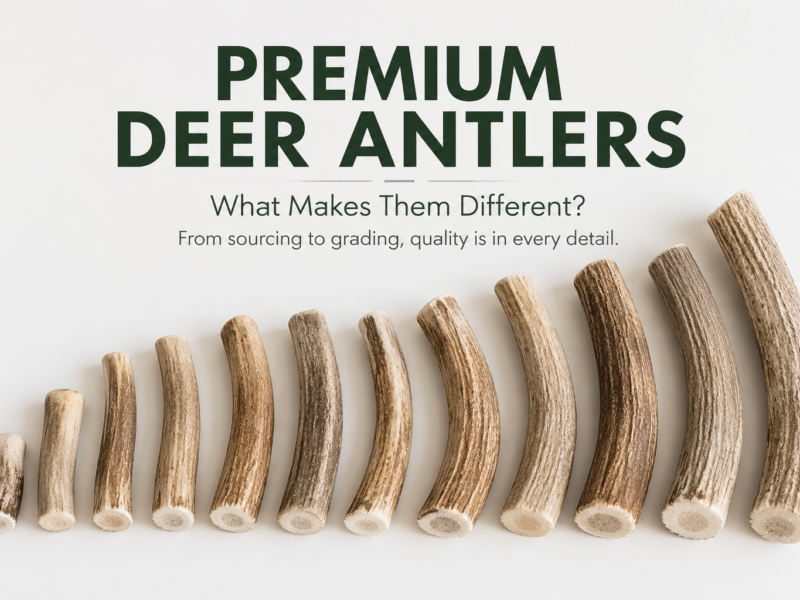
Each naturally shed antler is unique. Natural differences in shape, colour, texture and structure form part of what makes the product natural.
Natural variation is expected. Unclear expectations are not.
Therefore, a professional supplier should help buyers understand where natural variation may occur and establish clear expectations around the characteristics that matter commercially.
This approach allows buyers to appreciate the product’s natural qualities without compromising their ability to plan and sell it.
Consistency Starts with Clear Communication
Quality consistency involves more than the physical product.
Communication also plays an equally important role.
Professional buyers need clear information about:
- Available products and formats
- Specifications
- Order requirements
- Expected availability
- Changes that may affect supply
- Documentation
- Delivery expectations
Good communication reduces uncertainty.
Especially in international trade, reducing uncertainty provides significant value. Moreover, timely updates allow buyers to adjust purchasing, inventory and customer communication before problems arise.
Consistency Supports Long-Term Partnerships
A supplier relationship rarely depends on a single successful order.
Instead, time provides the real test.
Can the supplier understand changing requirements?
Can they communicate clearly?
Can they maintain agreed quality expectations?
Can the buyer plan with confidence?
These questions become increasingly important as a business grows.
A supplier that provides consistency helps its customers build their own consistency. Therefore, reliability is not simply an operational benefit. It becomes part of the value a supplier provides.
Quality, Traceability and Reliability Work Together
Quality should not stand alone.
For professional buyers of natural pet products, three elements increasingly work together:
Quality.
The product meets the agreed expectations.
Traceability.
The buyer can understand and document the product’s journey and origin where required.
Reliability.
The supplier consistently communicates and delivers according to agreed expectations.
Together, these elements create a stronger foundation for long-term business relationships. Furthermore, they help buyers assess not only the product itself, but also the supplier’s overall approach.
What Should Buyers Ask a Supplier?
Before establishing a long-term supply relationship, professional buyers may want to ask:
- What product specifications are available?
- How does the supplier manage natural variation?
- How does the supplier communicate quality expectations?
- What information is available for traceability?
- How does the supplier communicate changes in availability?
- Can the supplier support recurring orders?
- How clearly does the supplier define formats, sizes and requirements?
The answers can tell buyers a great deal about how a supplier approaches quality. They can also reveal whether the supplier is prepared to support a dependable relationship beyond the first order.
From Product Quality to Supplier Reliability
A premium natural product is important.
However, for a distributor, the value of that product depends partly on the reliability of the relationship behind it.
The strongest supplier relationships rely on more than a good first order. Instead, they develop through clear expectations, consistent quality, transparent communication and the ability to work together over time.
At Deer Export, we believe that working with natural products means respecting natural variation while maintaining professional standards around quality, communication and supply.
Ultimately, quality once is a good product. Quality consistently is a good supplier.